

Sample Business Continuity Plan (BCP): Free Template & Expert Guide
Unexpected disruptions—whether cyberattacks, natural disasters, or system failures—can devastate a business.
That’s why a well-structured sample business continuity plan (BCP) is essential.
This guide walks you through what a BCP is, why it matters, and provides a free template to help you safeguard operations, protect data, and minimize downtime.
With the right plan in place, your business can recover quickly and continue serving customers without missing a beat.
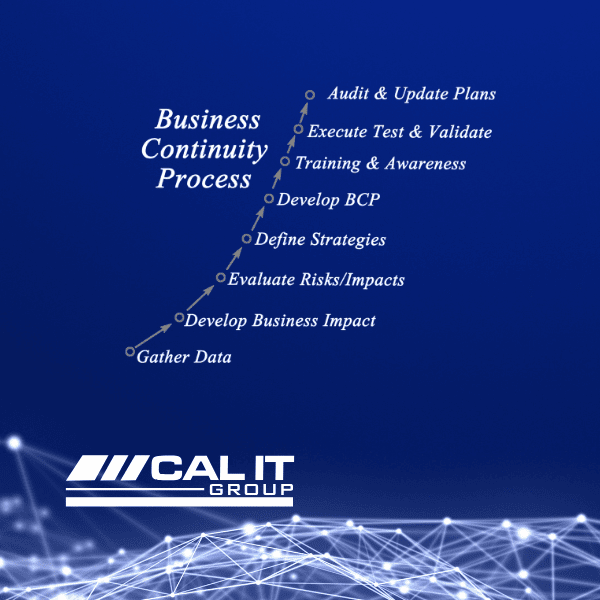
Key Takeaways
- Ready‑to‑use template: A downloadable sample plan outline you can adapt in minutes.
- Assists in plan development: The template is designed to assist users in developing or tailoring their business continuity strategies, ensuring effective and compliant plans.
- Strategic framework: Five essential pillars—risk assessment, recovery strategies, documentation, training, and continuous improvement.
- Compliance‑friendly: Aligns with ISO 22301, NIST SP 800‑34, and FFIEC guidelines.
- Performance metrics: 8 KPIs to prove resilience ROI.
- Expert support: CAL IT Group delivers 60‑second response managed IT, cybersecurity, cloud, and disaster‑recovery services to keep your BCP future‑proof.
What Is a Business Continuity Plan?
A business continuity plan (BCP) is a formal, structured document that outlines how an organization will prevent, respond to, and recover from disruptive incidents. Unlike a disaster recovery (DR) plan focused purely on IT, a BCP covers the enterprise’s people, processes, facilities, and technology.
Core Components of an Effective BCP
Risk Assessment & Business Impact Analysis (BIA)
- Identify threats: natural hazards, cyber incidents, and supply disruptions.
- Quantify impacts: revenue loss, legal penalties, reputational damage.
- During the risk assessment and Business Impact Analysis (BIA), determining the likelihood of various risk factors is essential for prioritizing threats and developing effective mitigation strategies.
Recovery Strategies
- Alternate sites: hot, warm, or cold data centers.
- Cloud failover: multi‑region redundancy.
- Manual workarounds: paper forms, phone trees.
These recovery strategies are essential for recovering business operations and maintaining productivity if the primary office is unavailable due to a disaster or disruption.
Plan Development & Documentation
- Create the plan with input from all relevant departments and assign responsible individuals for each role.
- Roles, responsibilities, and RACI matrices.
- Step‑by‑step playbooks for each scenario.
Training & Testing
- Tabletop exercises every 6 months.
- Full interruption simulation annually.
It is important that the BCP is regularly tested to ensure it remains effective and can be relied upon during real-world disruptions.
Continuous Improvement
- Post‑incident reviews.
- Version control with audit trails.
The plan must be regularly reviewed to ensure compliance and effectiveness while maintaining its relevance through ongoing updates and improvements.
Struggling with tech headaches? CAL IT Group’s Orange County experts make pinpointing the perfect IT solution effortless. Get in touch today and let’s tailor the right fit for you!
Business Continuity Management: An Overview
Business continuity management is the comprehensive process that ensures your organization can continue operating smoothly during unforeseen events, such as natural disasters, cyberattacks, or equipment failures.
At the heart of this approach is the business continuity plan, which details the procedures and strategies needed to maintain critical business functions and minimize disruptions to business operations.
Effective business continuity planning involves identifying potential risks, assessing their impact on your organization, and developing robust recovery procedures to guarantee operational continuity.
By prioritizing business continuity, organizations can safeguard their reputation, maintain client trust, and ensure the uninterrupted delivery of critical services, even in the face of significant disruptions.
This proactive approach helps maintain essential functions and equipment and positions your business to recover quickly and efficiently from any challenge.
Leveraging Business Continuity Technology
Modern business continuity relies heavily on technology to ensure organizations can continue operating during disruptions.
Cloud-based backup and disaster recovery solutions provide secure, off-site storage and rapid data restoration, minimizing downtime and protecting against data loss.
Instant virtualization allows critical systems to be spun quickly in the cloud, ensuring that internal systems and essential services remain available even if primary infrastructure is compromised.
Advanced technologies like ransomware detection and automated failover reduce risk and support seamless business operations.
Additionally, business continuity technology enables remote work, allowing employees to access systems and data securely from any location.
By leveraging these tools, organizations can maintain the continuity of critical services, support their workforce, and ensure that business operations remain resilient in the face of unexpected events.
Sample BCP Template
Download Free BCP Template Here
Section‑by‑section outline:
- Executive Summary
- Objectives & Scope
- Risk Assessment Findings
- Business Impact Analysis Results
- Recovery Time & Point Objectives (RTO/RPO)
- Recovery Strategies & Resources
- Communication Plan (how to communicate with internal and external stakeholders during disruptions)
- Emergency Contact Information
- Plan Activation & Escalation Matrix
- Training & Testing Schedule
- Maintenance & Revision Log
Beat IT roadblocks with CAL IT Group. Our Orange County specialists deliver dependable, customized support that keeps your business humming. Tap “Managed IT” and get started now.
Real-Life Examples of Business Continuity in Action
Real-world examples highlight the importance of having a robust BCP in place. For instance, when a company experiences a major outage, such as a power failure or cyber incident, a well-prepared BCP enables the rapid recovery of critical systems, maintains communication with clients, and ensures the uninterrupted delivery of services.
In another example, an organization affected by a natural disaster can use its continuity plan to relocate operations, keep internal systems running, and preserve critical business functions. These scenarios demonstrate how effective business continuity plans empower organizations to continue operating, protect their reputation, and maintain client relationships during disruptions.
By studying such examples, businesses can better understand the value of planning and develop strategies tailored to their unique risks and operational needs.
Customizing the Template for Your Industry
Business associates (HIPAA): If you handle protected health information for healthcare clients, add HIPAA‑compliant ePHI handling procedures. Ensure your BCP covers the HIPAA obligations in your business associate agreements.
Manufacturing: Include supplier continuity agreements and inventory buffers. Ensure your plan addresses industry-specific regulations governing manufacturing processes and safety standards.
Financial Services: Map controls to the FFIEC Business Continuity Handbook. Confirm that your BCP is updated to reflect current financial regulations and compliance requirements.
Common Mistakes to Avoid
- Overlooking third‑party risk—vendors need BCPs, too.
- Stale documentation—review at least quarterly.
- Unrealistic RTOs/RPOs—align with actual system capabilities.
How CAL IT Group Can Help Develop Your Business Continuity Plan
CAL IT Group is dedicated to helping organizations develop, implement, and maintain effective business continuity plans.
With deep expertise in business continuity planning, CAL IT Group offers comprehensive services such as business impact analysis, risk assessment, and disaster recovery planning to ensure your organization is prepared for any disruption.
Their team works closely with clients to create tailored BCPs that address critical business functions and support operational continuity.
Whether you need to develop a new continuity plan or review and update an existing one, CAL IT Group provides the guidance and resources necessary to minimize risk and maintain essential services.
Organizations can confidently navigate disruptions by partnering with CAL IT Group, knowing their business continuity plans are robust, up-to-date, and aligned with their overall business strategy.
How CAL IT Group Supports Your Business Continuity Plan
CAL IT Group (contact us) pairs strategic guidance with hands‑on technical execution so your sample business continuity plan succeeds in real life, not just on paper.
With a proven ability to deliver effective business continuity solutions, CAL IT Group ensures your organization is prepared to maintain operations during unexpected events.
The result is a robust BCP that helps contain damage and prevent data breaches, enabling your organization to recover quickly from disruptions such as natural disasters, cyberattacks, or transportation failures.
Managed IT Services & Rapid Support
- 60‑second response during business hours, remote and on‑site.
- Proactive monitoring, patching, and incident resolution.
Cybersecurity Solutions
- Threat detection & response (MDR/XDR).
- Compliance‑aligned security assessments and penetration testing.
The security team is critical in executing incident response protocols, identifying and mitigating security breaches, and coordinating recovery efforts to ensure comprehensive protection.
Cloud & Disaster Recovery
- Multi‑cloud architecture, automated failover, and immutable backups.
- Ransomware‑resilient recovery with <15‑minute RTOs.
IT Consulting & Compliance
- ISO 22301 readiness, SOC 2, HIPAA, PCI DSS.
- Business impact analysis workshops and tabletop exercise facilitation.
It is essential to clearly define responsibility for BCP ownership and compliance to ensure all roles and duties are understood and properly executed during contingency events.
Additional Service Offerings
- VoIP & Unified Communications to keep teams connected during crises.
- Network Engineering & Wi‑Fi Optimization for resilient connectivity.
- Hardware Procurement & Lifecycle Management to prevent unplanned outages.
Next Step: Schedule a free 30‑minute BCP strategy call with CAL IT Group → Book Now.
Expert Guidance: Tips from Industry Leaders
Industry leaders agree that effective business continuity planning is essential for organizational resilience.
Their top recommendations include identifying potential risks and assessing their impact on critical business functions to ensure your continuity plan addresses the most significant threats.
Second, comprehensive recovery procedures should be developed and tested regularly to confirm they work as intended.
Third, ensure that all employees understand their roles and responsibilities during a disruptive event so everyone knows how to respond.
Fourth, maintain open communication with clients and stakeholders to build trust and keep them informed throughout any disruption.
Finally, regularly review and update your business continuity plan to keep it relevant and practical as your organization evolves.
By following these expert tips and collaborating with experienced partners like CAL IT Group, organizations can strengthen their business continuity plans and ensure they are prepared to maintain operations during unforeseen events.
Key Metrics to Track BCP Effectiveness
| KPI | Target | Why It Matters |
|---|---|---|
| Recovery Time Objective (RTO) | ≤ 1 hour for Tier 1 systems | Limits revenue loss |
| Recovery Point Objective (RPO) | ≤ 15 minutes | Minimizes data loss |
| Plan Coverage Ratio | 100% of critical processes | Ensures nothing is overlooked |
| Exercise Success Rate | ≥ 95% task completion | Validates readiness |
| Mean Time to Detect (MTTD) | ≤ 10 minutes | Faster incident awareness |
| Mean Time to Recover (MTTR) | ≤ 2 hours | Rapid restoration |
| Employee Training Completion | 100% annually | Maintains competence |
| Supplier BCP Compliance | 90%+ certified | Reduces third‑party risk |
Wrapping It Up
A sample business continuity plan is the springboard to a fully tailored, compliance‑ready BCP that keeps your organization operating through any disruption. Use the template, follow the framework, track your KPIs, and partner with experts like CAL IT Group to ensure every layer—from cybersecurity to cloud architecture—works flawlessly when it matters most.
Ready to strengthen your resilience? Contact CAL IT Group for a personalized roadmap today.
Frequently Asked Questions
What is the difference between business continuity and disaster recovery plans?
A BCP is enterprise‑wide and holistic; a DR plan focuses on IT infrastructure recovery.
How often should I test my sample business continuity plan?
Tabletop exercises every six months and a complete simulation annually are best practices.
Who should own the BCP in my organization?
Typically, the COO or CIO is supported by a cross‑functional continuity team.
How long does it take to develop a business continuity plan?
Small businesses may complete a plan in 4–6 weeks; complex enterprises can take 3–6 months.
Can CAL IT Group help if we already have an internal IT team?
Yes. CAL IT Group offers co‑managed IT and consultation to augment and empower internal staff.